

Introduction
You have recorded a song, mixed and mastered it, created the artwork, and finally have a finished master sitting on your computer.
Now comes the question every independent artist eventually asks:
How do I get my music onto Spotify, Apple Music, YouTube Music, Amazon Music and other streaming platforms?
The answer is music distribution.
A music distributor acts as the bridge between you and the digital music platforms where people listen to music. Instead of an artist having to negotiate separately with dozens of streaming services, a distributor can deliver the music, metadata and release information to multiple platforms on the artist’s behalf.
Spotify itself explains that music is uploaded to the platform through a distributor, which handles licensing and distribution and pays royalties earned from streams. Apple Music similarly describes distributors as partners that manage the relationship between artists and streaming services and handle content, metadata, financial information and royalty reporting.
But distribution is more than simply “putting your song on Spotify.”
It involves your audio files, metadata, artwork, identifiers, release dates, territories, rights information, royalties and, depending on the distributor, additional services such as YouTube monetization, analytics, publishing administration and more.
This guide explains how the entire process works and what independent artists should understand before releasing their next song.
What Is Music Distribution?
Music distribution is the process of delivering your recorded music to digital music platforms and making it available for listeners to stream, download or otherwise access.
In the traditional music industry, record labels and physical distributors handled the process of getting records into shops.
Digital distribution works differently.
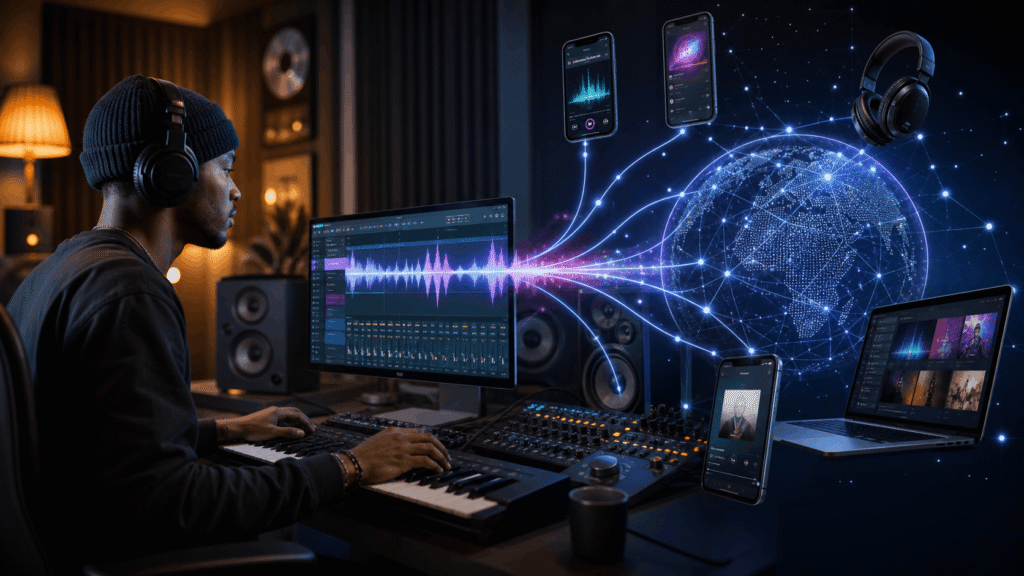
Today, an independent artist can work with a digital music distributor, upload a release once, provide the required information and have that distributor deliver the release to multiple digital services.
Depending on the distributor and the services selected, your music may be delivered to platforms such as:
- Spotify
- Apple Music
- YouTube Music
- Amazon Music
- Deezer
- TIDAL
- TikTok
- Instagram and Facebook music libraries
- Other regional streaming and download platforms
YouTube describes digital aggregators as companies that distribute music to services such as YouTube and YouTube Music. These companies can prepare metadata, handle industry-standard deliveries, provide licensing or analytics services and report earnings to artists.
So, in simple terms:
You create the music.
The distributor delivers it.
Streaming platforms make it available to listeners.
Royalties generated by usage are reported and paid through the relevant rights and distribution systems.
Why Do Independent Artists Need a Music Distributor?
One of the biggest advantages of digital distribution is that artists no longer need a traditional record label simply to make their music available worldwide.
An independent artist can record a song in a home studio, work with a professional mixing and mastering engineer, create artwork, choose a distributor and release the track to a global audience.
That is a huge shift from the traditional music industry.
Without a distributor, an artist would generally not have a direct upload button for every major streaming service. Instead, distributors and aggregators provide the technical and business infrastructure required to deliver music to these platforms.
Spotify, for example, directs artists to choose a distributor when they want to get their music onto Spotify.
For an independent artist, distribution can therefore provide:
1. Access to major streaming platforms
Your music can be delivered to multiple services without you having to build separate delivery relationships with each one.
2. Royalty collection and reporting
Distributors generally collect and report the revenue generated through the services they distribute to, according to their specific agreements and fee structures.
3. Global availability
Depending on the distributor and your rights, your music can potentially be made available across multiple countries and territories.
4. Release management
A distributor can handle important release information such as metadata, release dates, artwork and audio files.
5. Analytics
Many distributors provide dashboards showing information about streams, listeners, territories and other performance data.
Apple Music notes that distribution partners can provide analytics and other release-related services in addition to delivery.
How Does Music Distribution Work?
The process can look complicated from the outside, but the basic workflow is fairly straightforward.
Step 1: Create and finalize your recording
First, you need your finished master.
This normally means the song has already gone through:
Recording → Editing → Mixing → Mastering
Your distributor will have technical requirements for the audio file, so always check its current specifications before uploading.
Spotify recommends that artists export the highest-quality lossless files and follow their distributor’s upload guidelines.
Step 2: Prepare your metadata
Metadata is the information that tells platforms what your release actually is.
This can include:
- Artist name
- Track title
- Album or EP title
- Featured artists
- Songwriters
- Producers
- Composer information
- Genre
- Release date
- Original release date
- Track version
- Explicit-content information
- Copyright information
- Label information
- ISRC
- Release identifier such as UPC/EAN, where applicable
Metadata may look like boring administrative paperwork, but it is extremely important.
A great song with incorrect metadata can create problems with artist profiles, credits, royalty tracking and release identification.
Apple Music specifically highlights metadata as an important part of preparing a release.
What Is an ISRC Code?
If you have started researching music distribution, you have probably encountered the term ISRC.
ISRC stands for International Standard Recording Code.
It is a unique identifier assigned to a specific sound recording or music video.
Think of it as a permanent identification number for a particular recording.
The International ISRC Agency explains that an ISRC uniquely identifies a recording and remains associated with that recording even if ownership changes. ISRCs are widely used by digital music services and licensing organizations for identifying recordings, reporting usage and administering revenue.
For example, if you release:
“Song Name” by Artist X
the specific studio recording can have its own ISRC.
A different recording, such as:
- Acoustic version
- Live version
- Remix
- Radio edit
- Instrumental version
would generally have its own ISRC because it is a different recording.
The ISRC should therefore be treated as an important part of your release records.
If you are self-releasing, ISRCs can be obtained through the appropriate ISRC system or, depending on the distributor, the distributor may assign or provide them as part of its service. IFPI provides an online process specifically for self-releasing artists and creators.
Step 3: Upload Your Cover Artwork
Your distributor will also require cover artwork.
This is the artwork that listeners see alongside your release on streaming platforms.
Your distributor will have its own specifications for:
- Dimensions
- File format
- Resolution
- Text
- Logos
- Copyright information
- Content restrictions
Do not simply design an image and assume it will automatically be accepted.
A professional release should have artwork that is technically compliant and visually consistent with your artist identity.
Step 4: Choose Your Release Date
You can generally select when your music should become publicly available.
For example:
Upload: August 1
Release date: August 21
This gives your distributor time to process and deliver the release.
It also gives you time to prepare your marketing.
A common mistake among independent artists is uploading a song today and expecting everything to be live everywhere tomorrow.
That leaves very little room to fix:
- Metadata errors
- Artwork problems
- Artist-profile issues
- Content rejections
- Delayed deliveries
- Playlist pitching
- Marketing campaigns
For a professional release, plan your distribution before release day rather than treating distribution as the final five-minute task.
Spotify recommends that artists have their Spotify artist profile ready and notes that artists should give themselves time before release for playlist pitching and profile preparation.
Step 5: Your Distributor Delivers the Release
Once you submit the release, your distributor processes the information and sends the required assets and metadata to the selected music services.
This can involve industry delivery standards such as DDEX.
You don’t necessarily need to understand the technical details of DDEX to release music, but it helps to understand that your distributor is doing considerably more than simply uploading an MP3.
You are effectively handing the distributor a structured release package containing:
Audio + Artwork + Metadata + Rights Information + Identifiers
The distributor then delivers that information to supported platforms.
Step 6: Streaming Platforms Process the Release
After receiving the release, each platform processes and validates the material.
This is one reason why a distributor cannot always guarantee that every release will appear at exactly the same moment on every service.
Different platforms can have different processing requirements, systems and review processes.
Once accepted, your music can appear in the relevant catalogues.
Step 7: Listeners Stream or Purchase Your Music
Now the fun part begins.
Someone searches for your artist name.
They find your release.
They press play.
That usage can generate revenue depending on the platform, the type of use and the rights involved.
But this is where an important distinction needs to be made.
Music distribution and music publishing are not the same thing.
Music Distribution vs. Music Publishing
This is one of the most important concepts for independent artists to understand.
Music distribution deals primarily with the recording.
Distribution gets your recorded music to digital services and helps manage the associated delivery and reporting.
Music publishing deals primarily with the underlying composition.
The composition is the underlying musical work, including the songwriting and composition.
Consider a simple example.
You write a song called:
“Midnight Drive”
You write the lyrics and melody.
Then you record that song in a studio.
There are now two important layers:
Composition:
The underlying song you wrote.
Sound recording:
The specific recorded version of that song.
These two layers can generate different types of royalties and can involve different rights-management systems.
Apple Music explains that music publishing can involve performance, mechanical and synchronization uses, and that songwriters may work with publishers or other representatives to manage rights and revenue collection.
So, distributing your recording does not automatically mean that every possible royalty connected to the underlying composition has been registered and collected.
That is why independent artists should learn about both:
Recording rights + Songwriting/publishing rights
What Royalties Do You Get From Music Distribution?
This is where many new artists become confused.
There is no universal “Spotify pays X per stream” number that applies to every artist, every listener and every situation.
Revenue depends on factors such as:
- Platform
- Territory
- Subscription type
- Listening activity
- Rights ownership
- Agreements
- Distributor terms
- Label arrangements
- Applicable royalty systems
Spotify itself explains that royalty payments depend on the artist’s agreements with their label or distributor.
Therefore, be cautious whenever you see a headline such as:
“Spotify pays exactly ₹X per stream.”
That kind of calculation can be useful as a rough illustration, but it should not be treated as a guaranteed rate.
Does the Distributor Keep Your Royalties?
That depends entirely on the distributor.
Different distributors use different pricing models.
Common models include:
Annual or recurring subscription
You pay a recurring fee and the distributor may allow you to keep all or most of the royalties under its terms.
Per-release fee
You pay for individual releases.
Commission model
The distributor takes an agreed percentage of revenue.
Hybrid models
Some services combine subscription fees, commissions and additional paid services.
There is no single “best” model for every artist.
Instead, compare:
- Upfront cost
- Annual fees
- Commission percentage
- Number of releases allowed
- Royalty ownership
- Store coverage
- YouTube monetization
- Content ID options
- Publishing administration
- Analytics
- Support
- Takedown policies
- What happens if you stop paying
- Whether your releases remain online
The cheapest distributor is not automatically the best distributor.
What Happens If You Stop Paying Your Distributor?
This is an important question that artists often overlook.
Suppose you choose a distributor that charges an annual subscription.
You release 20 songs.
Three years later, you decide you no longer want to pay the subscription.
What happens to those 20 releases?
The answer depends on the distributor’s terms.
Some services may allow releases to remain available under certain conditions. Others may remove releases when the subscription ends.
This can have major consequences for an artist with years of accumulated streams and playlist placements.
Always read the distributor’s current terms before building your entire catalog around one service.
Can You Use More Than One Distributor?
Technically, an artist can work with different distribution services, but doing so requires careful catalog management.
For example, you might distribute one part of your catalog through one company and another part through a different company.
However, you should avoid accidentally delivering the same recording to the same platform through multiple distributors unless you understand exactly how the arrangement works.
Duplicate deliveries can create conflicts involving:
- Ownership
- Metadata
- Content ID
- Royalty reporting
- Artist profiles
- Takedowns
If you move an existing release from one distributor to another, preserve your existing identifiers and metadata where appropriate and follow the new distributor’s migration instructions.
ISRC is particularly important here because it identifies the specific recording rather than simply the release title.
What Is a Release Identifier Such as UPC or EAN?
You may also encounter identifiers associated with an entire release.
While an ISRC identifies an individual recording, identifiers such as UPC or EAN can be associated with a larger release package such as an album or single release.
The distinction becomes useful when managing catalogs.
For example:
| Identifier | Generally identifies |
|---|---|
| ISRC | Individual sound recording |
| UPC/EAN | Release/product package |
| Artist name | The performing artist |
| Song title | The individual composition/recording title |
YouTube’s delivery documentation, for example, identifies tracks using combinations involving ISRC and release identifiers such as UPC, EAN or GRid.
What Platforms Can Your Music Reach?
The exact list depends on your distributor and the territories and services it supports.
Common destinations can include:
- Spotify
- Apple Music
- YouTube Music
- Amazon Music
- Deezer
- TIDAL
- TikTok
- Regional music services
- Download stores
You should always check the distributor’s current store list before signing up because platform coverage and available features can change.
For example, Apple maintains a directory of distribution partners that support delivery to Apple Music, with different partners offering different capabilities such as lyrics, analytics, credits and Spatial Audio.
What About YouTube?
YouTube deserves special attention because music distribution on YouTube is not exactly the same thing as simply uploading a music video to your channel.
A distributor can deliver your audio release to YouTube Music and can also be involved in systems that create official music assets and manage certain rights.
YouTube explains that even if an artist uploads music videos directly to their own channel, audio files and metadata still need to be delivered to YouTube to make the music fully available across YouTube and YouTube Music.
Distribution can therefore complement your own YouTube channel rather than replace it.
Your strategy might include:
Distributor:
Official audio / YouTube Music delivery
Your YouTube channel:
Music videos, lyric videos, behind-the-scenes content, live performances and other original content
Eligible artists can also work toward an Official Artist Channel, which brings different artist-related content and subscribers together and provides additional artist tools. YouTube states that having at least one official music release delivered through a distributor or label is one of its eligibility requirements.
Does Music Distribution Promote Your Music?
Usually, no.
This distinction is extremely important.
A distributor’s primary job is generally to deliver and manage your music across digital services.
That does not mean the distributor will automatically make your song popular.
Distribution can put your song on Spotify.
It cannot guarantee that people will listen to it.
Think of it this way:
Distribution builds the road.
Marketing tries to get people onto it.
Your marketing strategy might involve:
- Social media content
- Short-form videos
- YouTube videos
- Live performances
- Collaborations
- Influencer campaigns
- Playlist pitching
- Press
- Email marketing
- Fan communities
- Artist branding
- Paid advertising
Some distributors offer marketing tools or promotional services, but these should be evaluated separately from basic distribution.
Apple notes that distributors can offer additional marketing tools and strategy, but the exact services differ between providers.
How Early Should an Independent Artist Distribute a Song?
There is no universal number of days that guarantees success.
However, do not make release day the day you upload your music.
Give yourself enough time for:
- Uploading the release
- Distributor processing
- Platform delivery
- Fixing metadata or artwork issues
- Claiming or updating artist profiles
- Preparing promotional content
- Pitching opportunities where available
- Building anticipation
For example, if your song is planned for release on October 30, you could aim to have the release prepared and submitted well before that date.
The exact timeline should depend on your distributor, your release strategy and whether you are planning editorial pitching or a larger campaign.
What Do You Need Before Distributing a Song?
Before uploading, create a release checklist.
Audio
- Final mastered WAV or required lossless format
- Correct track version
- Correct start and end
- No accidental clipping or unwanted silence
- Final quality check
Artwork
- Correct dimensions
- Correct file format
- High resolution
- No unauthorized images
- No misleading platform references
- Proper artist and title information
Metadata
- Artist name
- Track title
- Release title
- Featured artists
- Songwriters
- Producers
- Genre
- Explicit-content status
- Release date
- Copyright information
- Label information if applicable
- ISRC
- Release identifier where applicable
Rights
Make sure you actually have the rights necessary to distribute the material.
This is particularly important if your song contains:
- Samples
- Interpolations
- Third-party beats
- Licensed vocals
- Cover versions
- Stock audio
- Collaborative recordings
Do not assume that buying a beat automatically gives you unlimited rights to every possible use.
Read the relevant license.
Common Music Distribution Mistakes
1. Uploading the wrong audio file
Once a release is live, fixing a master can be more complicated than simply replacing a file before release.
Always perform a final quality-control check.
2. Spelling the artist name incorrectly
A single metadata mistake can create confusion around artist profiles.
Check every field before submitting.
3. Using inconsistent artist names
If your artist name is:
ARJUN
don’t randomly submit another release as:
Arjun
or:
ARJUN OFFICIAL
unless you intentionally want separate artist identities.
Consistency matters.
4. Ignoring songwriting credits
Your distributor’s release metadata and your publishing administration are related but not necessarily the same thing.
Make sure the correct writers and contributors are documented.
5. Assuming distribution equals promotion
Getting onto Spotify is not the same as building an audience.
Distribution is infrastructure.
Marketing is what you build on top of it.
6. Choosing a distributor only because it is cheap
Price matters, but it should not be the only factor.
A slightly more expensive service may provide better support, analytics, monetization options or catalog management.
7. Not keeping your own records
Maintain your own master catalog containing:
- ISRCs
- UPC/EANs
- Masters
- Artwork
- Lyrics
- Credits
- Contracts
- Distributor information
- Release dates
- Copyright information
Never make your distributor dashboard the only place where your music business records exist.
How Should an Independent Artist Choose a Distributor?
Instead of asking:
“Which distributor is the best?”
ask:
“Which distributor is best for the way I release music?”
Consider these questions:
How often do you release?
If you release one or two songs a year, a per-release model might make sense.
If you release frequently, a subscription model could potentially be more economical.
Do you want to keep 100% of your distribution royalties?
If yes, pay close attention to commission structures.
Do you need YouTube monetization?
If YouTube is a major part of your strategy, investigate exactly what the distributor offers.
Do you need publishing administration?
Some distributors provide publishing-related services, but distribution and publishing remain different areas of rights administration.
Do you need advanced analytics?
If you are serious about building a career, data can become increasingly valuable.
What happens when you leave?
This deserves special attention.
Find out what happens to your catalog if you cancel your subscription or move to another distributor.
Music Distribution Is Only One Part of an Artist’s Career
It is easy to think of music distribution as the finish line.
It is actually closer to the starting gate.
A successful independent music release typically involves several connected areas:
Music Creation
↓
Recording & Production
↓
Mixing & Mastering
↓
Rights & Credits
↓
Music Distribution
↓
Streaming Platforms
↓
Marketing & Promotion
↓
Audience Growth
↓
Royalty & Data Management
Distribution makes your recording available.
But your long-term career depends on what you do before and after that release.
The strongest independent artists treat every release as part of a larger system rather than as an isolated upload.
Final Checklist: Before You Distribute Your Next Song
Before pressing the submit button, ask yourself:
Audio
- Is this the final master?
- Have I listened to the complete file?
- Is the file in the required format?
Metadata
- Is the artist name correct?
- Is the title correct?
- Are all contributors credited?
- Is the explicit-content status correct?
- Is the release date correct?
Artwork
- Is the artwork technically compliant?
- Do I own or have permission to use every element?
- Does the artwork represent the release professionally?
Rights
- Do I own or control the rights required to distribute this recording?
- Are samples properly cleared?
- Are collaborators properly documented?
- Do I understand the rights associated with any beat or third-party material?
Identifiers
- Does the recording have the correct ISRC?
- Have I recorded the ISRC in my own catalog?
- Do I have the relevant release identifier?
Distribution
- Does the distributor deliver to the platforms I need?
- What fees does it charge?
- Does it take a commission?
- What happens if I cancel?
- What additional services do I actually need?
Marketing
- Do I have a release campaign?
- Have I prepared social content?
- Have I prepared links and promotional assets?
- Have I given myself enough time before release day?
If you can answer these questions confidently, you’re much closer to releasing your music like a business rather than simply uploading a file and hoping for the best.
Frequently Asked Questions
Is music distribution free?
Some distributors offer free or low-cost distribution models, while others charge per release, annually or take a percentage of royalties. Pricing and features vary, so compare the current terms rather than choosing based solely on the headline price.
Can I distribute music without a record label?
Yes. Independent artists can distribute their music through digital distributors without signing to a traditional record label.
Does a distributor own my music?
Not necessarily. Distribution agreements vary, and some services may only provide distribution while others may involve additional rights or licensing arrangements. Always read the agreement carefully before signing up.
Can I distribute a single myself?
Yes. A single can be distributed independently through a digital distributor.
How long does music distribution take?
It varies by distributor and platform. Processing and delivery can take different amounts of time, so artists should submit releases in advance rather than relying on last-minute delivery.
Does distribution guarantee Spotify streams?
No. Distribution makes your music available. It does not guarantee listeners, playlist placements, viral growth or a specific number of streams.
Do I need an ISRC code?
Your recordings need to be properly identified within the digital music ecosystem, and ISRCs are the standard identifiers used for individual sound recordings. Depending on your distributor and circumstances, the distributor may provide or assign them, or you may obtain them through the appropriate ISRC process.
Is music distribution the same as music publishing?
No. Distribution primarily concerns the delivery and administration of recorded music, while publishing concerns the underlying musical compositions and their associated rights.
Can I change distributors later?
Yes, artists can move catalogs between distributors, but the process should be handled carefully. Maintain your ISRCs, metadata and release information and follow the new distributor’s migration instructions.
Conclusion
Music distribution has fundamentally changed what is possible for independent artists.
You no longer need to manufacture physical records, convince a major label to sign you or build individual relationships with every major streaming service simply to make your music available to listeners around the world.
With the right distributor, an independent artist can deliver a professional release to a wide range of digital platforms while maintaining much greater control over their career.
But distribution should not be confused with everything else that happens around a release.
Distribution gets the music where it needs to go.
Your rights management helps ensure the correct people are credited and paid.
Your marketing brings attention to the release.
Your content builds an audience.
And your music is what gives people a reason to stay.
For independent artists, understanding how these pieces fit together is one of the first steps toward treating music not just as a creative pursuit, but as a sustainable professional career.